Choosing the right transformer is an in-depth process. Before electrical contractors can consider voltages, enclosures and efficiency standards, they must decide whether a dry type or oil-filled transformer unit best suits their application. Even then, they must decide between dry type transformer manufacturers to balance cost and quality.
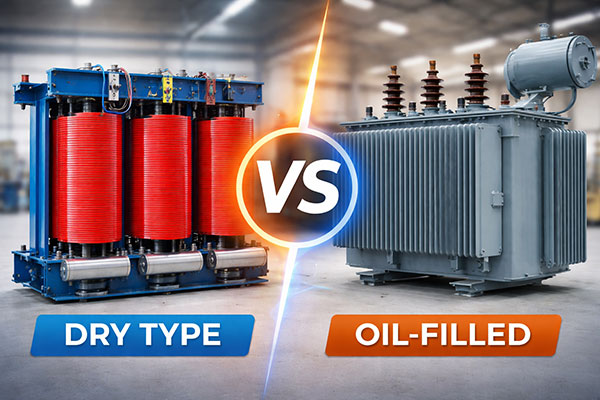
How Do Dry Type and Oil-Filled Transformers Compare?
Dry type transformers require less maintenance than their fluid-filled counterparts. They also pose minimal fire and environmental risks, making them ideal for indoor applications. They can be kept close to the systems they power, reducing the likelihood of voltage drops.
Oil-filled transformers are ideal for outdoor, utility-scale or long-duty-cycle applications because they handle higher loads more effectively. However, they require environmental and fire protection measures, including periodic oil testing.
| Transformer Type | Dry Type | Oil-Filled |
| Cooling Mechanism | Air circulation | Mineral oil or ester fluids |
| Insulation | Solid fiber, resin or sheets | Dielectric oil |
| Fire Risk | Minimal | High — requires precautions |
| Environmental Risk | Minimal | High due to oil spill risk |
| Noise Level | 65 to 76 dB due to fans | 55 to 65 dB due to pumps |
| Best For | Indoor applications | Utility-scale applications |
How to Choose the Right Transformer for Your Project
Every system is unique, so there is no one-size-fits-all solution. However, contractors can use this decision-making framework to choose the right transformer for their project. The first step is to analyse application requirements — efficiency, voltage, capacity and operating environment.
Next, they must consider relevant standards. Those in North America may follow American National Standards Institute (ANSI) guidelines. The International Electrotechnical Commission’s (IEC) regulations are pertinent to European businesses. Going beyond the basics of compliance is key, as rules may change within the new device’s expected service life.
Deciding between new and remanufactured solutions has long-term implications. Alternatively, some dry type transformer manufacturers can retrofit stock units to fit existing setups, allowing customers to avoid the wait associated with long-lead-time items.
The last step in the decision-making framework is to evaluate warranty length and service life cycle. Post-sales support is vital for minimising downtime, shortening intervention time lines and extending the system’s longevity.
Key Regional Considerations for Transformer Selection
In the United States, most homes use a 120/240 V, 60 Hz system. Transformers are held to standards set by the National Electrical Manufacturers Association (NEMA), ANSI, the U.S. Department of Energy (DOE) and Underwriters Laboratories.
In colder climates, fluid-filled transformers may need heaters and low-pour-point fluids to maintain the proper viscosity. For locations prone to warmer weather, additional cooling equipment may be necessary. Damage increases exponentially the farther units go beyond their temperature and insulation limits.
Many European homes use a 230/400 V, 50 Hz system — about twice that of North America. The IEC 60076 standard and Tier 2 Ecodesign Regulations set important safety, environmental and efficiency criteria.
Although Europe’s climate is temperate, many areas experience significant rainfall or low ambient temperatures. Strict moisture control is necessary to prevent dielectric failure or corrosion. Oil monitoring, sealed tanks and anti-condensation heaters are practical solutions.
Choosing Between Dry Type Transformer Manufacturers
Choosing the right transformer starts with selecting an appropriate supplier. Global original equipment manufacturers (OEMs) are large, multinational companies with broad portfolios. They produce well-known brands with a reputation for quality and reliability.
Since regional specialists serve specific areas, they have a deep understanding of local regulations, climate conditions and market needs. They are often more flexible than OEMs in providing tailored solutions and fast turnaround times because they do not have to deal with the hassle of international shipping.
Application-focused dry type transformer manufacturers deliver tailored solutions to specific industries. As such, they have an in-depth understanding of features, challenges and compliance requirements needed. Their technical support and focused research and development efforts are ideal for those seeking a transformer optimised for a specific use case.
| Supplier Type | Global OEM | Regional specialists | Application specific |
| Key Benefit | Well known with a positive reputation | Typically more flexible than OEMs | Offers specialised products or services |
| Service Area | Multinational service area | Specific geographic area | Certain industries or applications |
| Expertise | Large, utility-scale projects | Tailored solutions with fast turnarounds | Niche applications and custom jobs |
| Knowledge Base | Grasps international standards | Deep understanding of local market needs | In-depth knowledge of specific use cases |
| Best for | Global operations requiring support across countries | Companies looking to balance cost and quality | Those seeking a high degree of support or specialisation |
The Top 3 Dry Type Transformer Manufacturers
Whether contractors are proactively replacing ageing units or sourcing an emergency replacement unit to minimise downtime, they should only trust top-rated suppliers. Superior build quality translates to enhanced performance, efficiency and longevity.
- ELSCO Transformers
Founded in 1912, ELSCO Transformers has served commercial customers across North America for over a century by engineering, building, repairing and selling transformers. It is one of the few that designs and manufactures high-quality copper-wound dry type units. It has had zero product failures since it began producing its own in 1988.
Its medium voltage transformers have a 30-year service life expectancy. As evidence of the transformer’s superior build quality, ELSCO offers a five-year warranty on all new indoor systems, which is five times longer than the industry standard. It even has emergency replacement services. Orders can leave the facility within 24 to 48 hours, depending on what modifications need to be made.
- Schneider Electric
As a leading global technology company, Schneider Electric has an in-depth understanding of electrification and digitalisation. Founded in 1836, it has grown into a multinational corporation with over 1 million partners in 100 countries. It has local distributors, integrators and resellers located worldwide.
It supplies low and medium-voltage transformers designed to meet or exceed specific DOE standards. Its non-ventilated general-purpose model is ideal for use in dust-prone environments. There are dry type units designed for either indoor or outdoor use.
- KONČAR
Since its founding in 1921, KONČAR has developed over a century of experience in power engineering. Over 33% of the company’s technicians, engineers and technologists hold advanced degrees.
As a regional leader, it designs and manufactures transformers to the highest quality standards. It supplies medium power transformers up to 160 MVA with a maximum voltage of 170 kV. They are suitable for both indoor and outdoor use. Each year, it delivers over 10,000 systems to over 110 countries.
FAQs About Dry Type Transformer Selection
The more decision-makers know, the easier it is for them to choose the right transformer manufacturer and model.
How Often Do Dry Type Transformers Need Maintenance?
Maintenance frequency depends on the facility’s environmental conditions. In a clean, dry space, a dry type transformer can go up to 12 months between inspections. In less ideal conditions, it may need to be checked every three to six months.
How Do I Specify Low-Noise Dry Type Transformers?
Noise levels vary between transformers — even those of identical voltage and kVA rating. Customers can request that manufacturers dampen noise below IEC or NEMA standards through vibration isolation, enhanced core construction or acoustic enclosures.
What IP Rating Do I Need for Dusty or Humid Environments?
An ingress protection (IP) rating of IP65 — complete protection against dust and resistance to direct, low-pressure water jets — is ideal, even for indoor units. However, IP54 is suitable because it provides limited protection from dust and water ingress.
Finding the Best Dry Type Transformer for the Job
While deciding between dry type and fluid-filled systems is a major decision, supplier choice may have an even bigger impact on performance and longevity. The best dry type transformer manufacturers offer superior build quality and compliance adherence. Decision-makers can pick just one, so they should make their decision carefully.