Operations Director, Jean-Luc Pizzol of CILS International discusses the dangers of outgassing in electronics applications and why NASA approved materials are slowly becoming the industry standard for electronics labelling.
If you’ve ever noticed the distinctive scent of a new car’s plastic interior or been hit by the sharp fumes of a freshly painted room, you’ve experienced the effects of outgassing. While these examples may evoke nostalgic connotations, outgassing can present significant risks for electronics manufacturers and end users, limiting product performance and lifespans. When left unmitigated, it can silently wreak havoc, causing bubbling, condensation, shorting and loss of adhesion between components.
So how does it occur, what can be done to stop it and how on earth does NASA tie into all of this?
Let’s dig a little deeper.
Science of Outgassing
Emissions from certain materials can migrate and settle on adjacent surfaces, introducing foreign compounds that impede proper device operation, potentially leading to malfunctions. Materials with suboptimal outgassing characteristics risk compromising the function and longevity of systems such as electronic components and precision instruments, often resulting in lasting impairment or total operational failure.
For example, when outgassing occurs within proximity of a lens, conformal coating, or contact surface, it can cause fogging, insulation issues or failures that are nearly impossible to diagnose post-assembly.
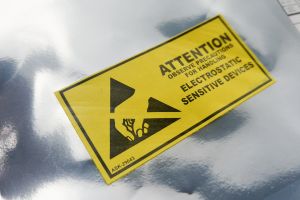
Outgassing is a particularly prominent issue within electronics labelling applications. For risk-intolerant and highly regulated environments, compromised labels can lead to safety risks and product recalls. When substrates are exposed to extreme temperatures, prolonged storage and varying environmental conditions throughout transportation, the likelihood of outgassing compromising labelling increases exponentially. Conveniently, these accelerating factors are all incredibly common within electronics supply chains.
Outgassing tends to be most problematic for adhesives that cure via solvent evaporation or moisture exposure, including various pressure-sensitive and contact types, as well as related sealants and encapsulants.
However, even within adhesive families, outgassing potentials and resistances can vary substantially. Unfortunately, there is a lack of a standardised singular adhesive chemical for outgassing prevention. Due to this, when assessing outgassing resistance, engineers and product specialists often look towards adhesives recognised by industry standards such as ASTM E595, developed by NASA.
NASA’s Testing for Outgassing-Resistant Labelling
ASTM E595 is NASA’s way of stress-testing materials to see how much mass they lose as vapour (Total Mass Loss) and how much turns into condensable residue (Collected Volatile Condensable Materials). For a label to pass, it must meet set criteria such as TML below 1.0% and CVCM below 0.10%.
In electronics applications, this testing may be relevant for manufacturers with highly automated production lines, strict ISO quality commitments or for those who are utilising ID labels near optics, high-reliability connectors or inside sealed, low-pressure PCB housings.
As a durable label manufacturer, this has led us to produce and certify a range of labels that utilise low-volatile films, engineered adhesives and fully cured, low-migration inks. Having spent over a decade working with engineers to meet electronics and avionics industry requirements, I know that when your material is ASTM E595 certified, you can guarantee that you are selling an extremely durable product. ASTM E595 approval shows our customers that they can trust our labels not to quietly sabotage their electronics, be it a satellite or a smartphone.